The common bottleneck for beginner creators
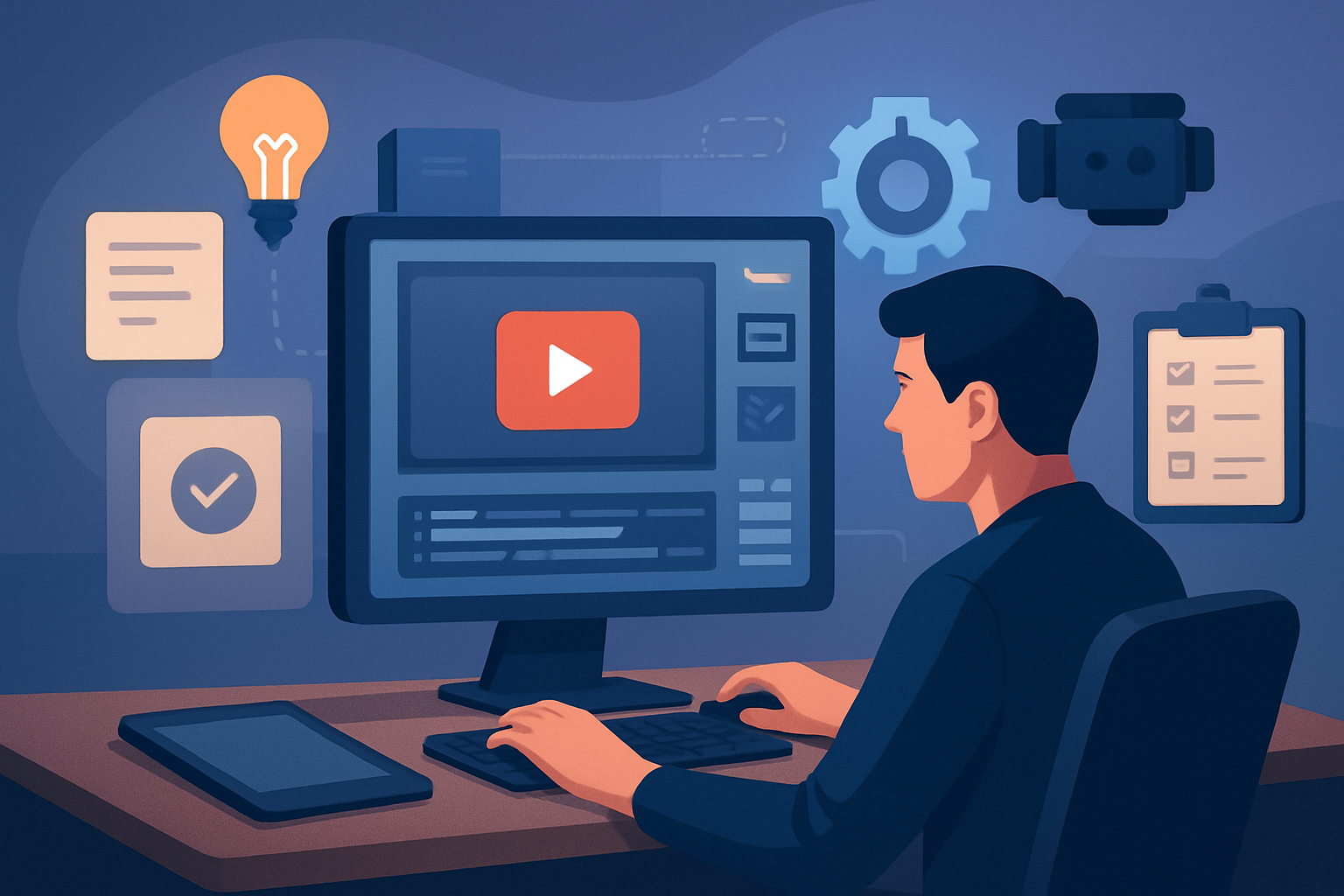
Beginners trying to automate YouTube hit the same choke points: inconsistent style, too many tools, slow first drafts, and a long manual finish pass before a video is publish-ready. You can generate ideas fast, but turning scripts or raw footage into repeatable, branded videos is where time leaks and errors kill momentum. A YouTube automation workflow for beginners should compress those steps into repeatable patterns that produce publish-ready outputs with minimal tool switching.
Step-by-step YouTube automation workflow for beginners
Idea and keyword capture
- Collect topics from audience comments, simple keyword research, and content gaps. Keep a running sheet with working titles and one-sentence hooks.
Batch script outlining (10–20 briefs)
- Write short scripts or bullet outlines for each title. For faceless explainers, include a hook, 3–5 bullets, and a CTA. Save these as a single folder.
Generate narration or draft audio
- Use TTS or recorded voice batches. Export clean audio files named for each script. If you prefer human narration, record in a consistent environment.
Import assets into a single workspace
- Bring scripts, audio, stock clips, and reference images into one project area so everything is reusable.
First-draft video generation
- Use a Text-to-Video or Auto Edit workflow to assemble the first draft automatically from the script or footage. Focus on getting timing, scene order, and basic cuts done.
One-pass finishing (branding, subtitles, hooks)
- Apply title hooks, subtitles, B-roll, overlays, and basic color/zoom adjustments. Treat this as a templated finish so each video follows the same visual identity.
Create thumbnails and export variants
- Generate thumbnails from the project and export video in necessary ratios (landscape for YouTube, portrait for Shorts).
Schedule and publish
- Upload, add metadata, and schedule. Track performance and feed learnings back into the idea sheet.
Repurpose and distribute
- Use the same project to export Shorts, clips, and repurposed posts. Keep assets in a reusable library for future batches.
Tools you’ll need
- A central video workspace/desktop editor that supports script-to-video and asset reuse (Shorz is an example of a Windows desktop AI video production suite that combines Auto Edit Video, Text-to-Video, Avatar, and Podcast project types in one persistent workspace).
- Script or copywriting tool (plain docs, AI writer, or Notion).
- TTS or recorded narration tool (for batch voiceovers).
- Thumbnail editor or the editor’s thumbnail generation feature (Shorz can generate and store thumbnails).
- Scheduling/publishing tool (YouTube Studio or any scheduler you prefer).
- Simple analytics tracking (YouTube’s analytics, a spreadsheet, or third-party tools).
Mistakes beginners make (and how to avoid them)
- Skipping a consistent style guide — create a 1-page visual and voice guide so every video looks and sounds like your channel.
- Treating AI draft as final — always apply finishing controls: subtitles, volume mix, and overlays.
- Not batching — producing one video at a time wastes context switching. Batch scripts, recordings, and exports.
- Ignoring thumbnails and hooks — thumbnails and the first 3–10 seconds drive click-through; don’t let them be an afterthought.
- Scattering assets across drives — centralize assets into a local library to speed repeatable work.
Optimization tips that actually move the needle
- Use short, testable hooks and A/B thumbnail variations. Keep templates for titles and CTAs.
- Preview in multiple ratios before export (landscape, portrait, square) to ensure crop-safe graphics. Shorz supports previews in different ratios to match platform formats.
- Reuse style reference images to stabilize the channel’s visual identity across generated scenes.
- Export captions and upload them with your video for better SEO and accessibility.
- Keep a “winning format” template — once a format performs, clone it for faster future production.
How to scale the workflow
- Template everything: intro, hook, subtitle styles, thumbnail frames, and export presets.
- Build a reusable asset library of B-roll, emojis, borders, and thumbnail elements. Shorz’s My Assets system stores videos, images, generated thumbnails, audio, and downloaded GIFs for reuse.
- Batch scripts and voiceovers weekly, then batch-generate first drafts in the workspace.
- Turn top-performing videos into multi-language versions by swapping narration and subtitles.
- Hire junior editors to run the finishing pass using your templates and the same workspace, reducing onboarding friction.
Where Shorz reduces friction in this workflow
- Workflow compression: Shorz helps move from source material to publish-ready faster inside one persistent desktop workspace.
- Fewer tools: Each project type (Auto Edit Video, Text-to-Video, Avatar, Podcast) lives in the same app, reducing tool switching.
- Reusable assets: Local My Assets library stores and caches videos, images, thumbnails, audio, and GIFs for repeat work.
- Faster first drafts and controlled finishing: Shorz combines AI generation with finishing controls (subtitles, title hooks, B-roll, overlays, music, and volume mix) so the draft is already near-publish quality.
- Platform-ready previews: Preview and export in landscape, portrait, and square ratios to avoid surprises when repurposing for Shorts or Reels.
- Thumbnail and publishing-adjacent assets: The app can generate and store thumbnails alongside video outputs, keeping the whole package together.
- Style consistency: Use style reference images and saved patterns to stabilize visuals across generated scenes and videos.
FAQ
Q: Do I need footage to start automating videos?
A: No. You can start from scripts or uploaded audio using Text-to-Video or Avatar workflows. If you have footage, Auto Edit Video helps turn it into a first draft quickly.
Q: Is this workflow suitable for faceless channels?
A: Yes. The Text-to-Video and Avatar project types are designed for faceless explainers and scripted social videos. For a deeper faceless workflow, see Faceless YouTube Workflow With Shorz.
Q: Can beginners manage this without editing experience?
A: Yes. The goal is repeatable templates and a persistent workspace so beginners can produce consistent outputs while learning finishing controls.
Q: How do I keep visuals consistent across many videos?
A: Save style reference images, overlays, and title-hook templates in an asset library and apply the same finishing controls each time.
Q: Where can I learn workflow patterns for creators or agencies?
A: Check the creator-focused workflow guide here: YouTube Automation Workflow for Creators. Agency ops patterns are here: YouTube Automation Workflow for Agencies. If you’re focused on faceless channels, see: YouTube Automation Workflow for Faceless Channels.
CTA
Ready to build a repeatable faceless YouTube workflow and compress your production steps? Learn how Shorz’s workspace, templating, and asset library fit into a faceless channel pipeline: Faceless YouTube Workflow With Shorz.