The core bottleneck agencies hit
Agencies lose margin and speed at two friction points: moving a concept into a publish-ready video, and adapting that output across channels without duplicating work. Hand-offs between scripting, editors, and designers, plus tool sprawl, create long first-draft cycles and rework. The result: missed deadlines, inconsistent creative systems, and a high cost per asset.
A creator productivity system for agencies must compress those steps into a repeatable pipeline that produces faster first drafts, enforces consistent style, and reduces tool switching so teams can push more deliverables without losing quality.
Step-by-step workflow (operator-ready)
Intake & brief (15–30 minutes)
- Capture objectives, target platform, length, and key hooks.
- Attach reference images or previous assets to the brief. Use a consistent naming scheme and required deliverables checklist.
Source capture & asset collection (30–60 minutes)
- Pull client footage, logos, brand fonts, and reference images into a single project folder.
- If you need web assets, use URL ingestion into your local asset library to cache source media before editing.
Script & storyboard (1–2 hours)
- Write a short script with hook-first lines and clear CTA moments.
- Create a shot list mapped to script lines. For faceless or educational content, prepare style reference images to lock visual identity.
First-draft generation (30–90 minutes)
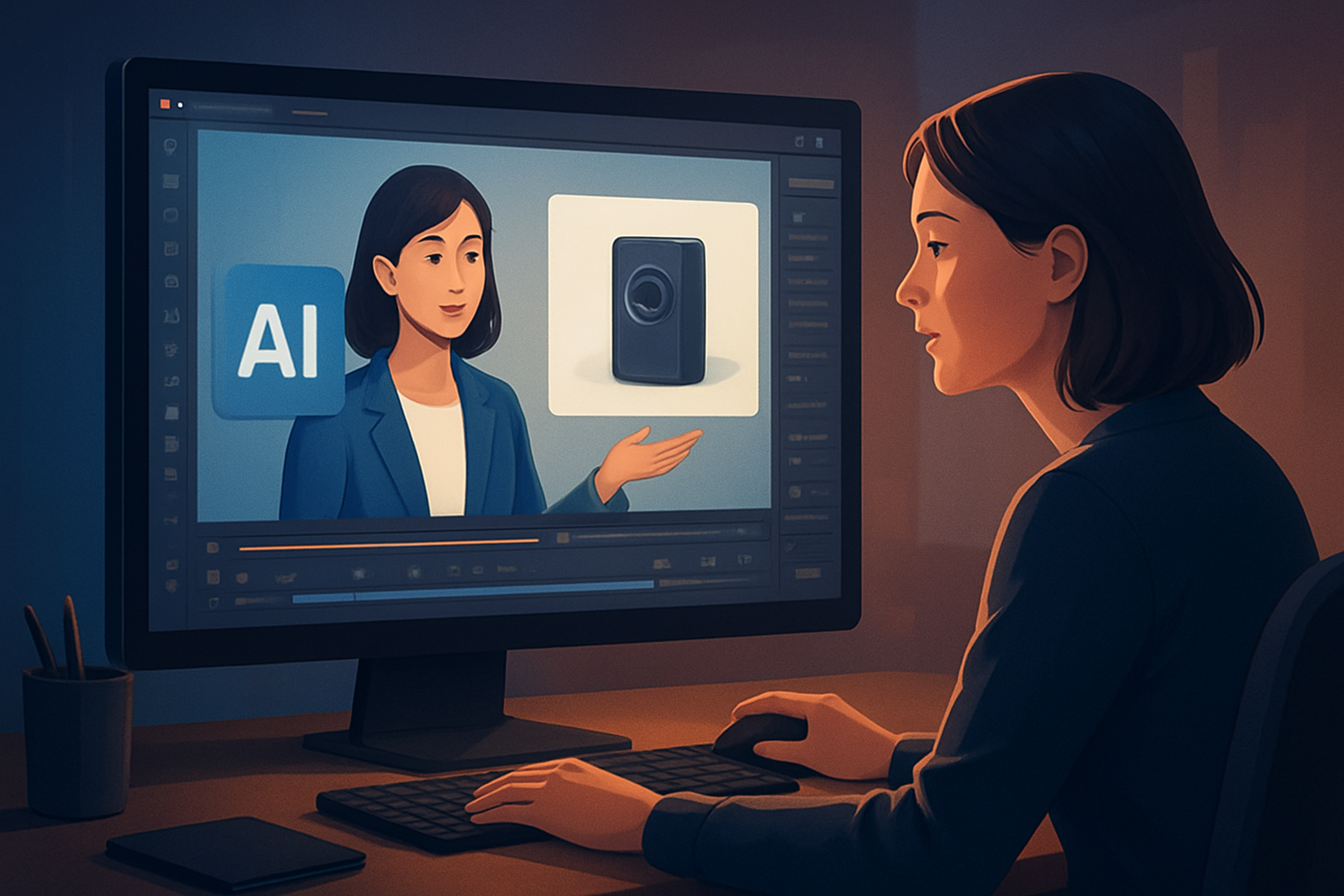
- Use an AI-assisted editor to produce a first pass: sync narration, cut for pacing, rough B-roll, and basic subtitles.
- Treat this draft as a scaffold to finish—don’t over-polish at this stage.
Finishing pass (30–60 minutes)
- Apply title hooks, subtitle styling, overlays, B-roll swaps, and mix audio levels.
- Add visual polish layers (auto zoom, face tracking, freeze-frames, basic color tweaks) where needed.
Platform proofing & thumbnail (15–30 minutes)
- Preview and adjust landscape, portrait, and square versions.
- Generate 3 thumbnails and pick the strongest for A/B testing.
Review, QA, and package (15–30 minutes)
- Run a quick checklist: captions accuracy, aspect ratio crops, audio levels, branding.
- Export final files and package thumbnails, captions, and any social copy for publishing.
Archive & reuse (ongoing)
- Save the project, versioned exports, and reused assets into your asset library so the next similar deliverable starts with structure and materials already in place.
This pipeline is intentionally modular—each step can be batched across assets to maximize throughput (script multiple videos, then batch first drafts, then finish).
Tools needed (lean stack)
- Central project tracker: Asana, Trello, or your agency PM tool for briefs and approvals.
- Shared storage: an on-prem or networked drive where local workstations can access source assets.
- Primary editor: a Windows desktop AI video production suite that supports Auto Edit Video, Text-to-Video, Avatar, and Podcast project types to compress first-draft work and reduce tool switching. For long-form or complex VFX, a traditional NLE can be used downstream.
- Audio tooling: basic DAW or audio editor if you do advanced mixing; otherwise use the editor’s audio assets and podcast-type workflows.
- Thumbnail and design: use the editor’s thumbnail generation plus a lightweight image editor for final tweaks.
- Social scheduler: your platform of choice for publishing.
If your agency focuses on daily output or faceless channels, tie the workflow to a repeatable template library and check out system patterns for daily posting cadence and faceless production approaches Creator Productivity System for Daily Uploads Creator Productivity System for Faceless Channels.
Common mistakes to avoid
- No templates: starting each video from scratch kills speed. Build reusable project templates and title/subtitle presets.
- Over-editing the first draft: AI-assisted first passes should be scaffolded and finished, not rebuilt.
- Ignoring aspect ratios: always preview portrait and square before final export to avoid late rework.
- Asset chaos: inconsistent naming and scattered source files make reuse impractical.
- One-tool expectation: expect some handoffs for complex projects; the goal is workflow compression, not universal replacement.
Optimization tips
- Lock style with reference images when using text-to-video or generated scenes. That stabilizes visual identity across episodes.
- Batch similar tasks (write 5 scripts in one session, generate 5 first drafts in the next).
- Use the asset library to store generated thumbnails, GIFs, and overlays for instant reuse.
- Create title-hook and subtitle presets for each client to keep cadence and voice consistent.
- Automate simple QA checks: caption completeness, resolution, and audio loudness targets before human review.
How to scale the workflow
- SOPs and role separation: define who drafts scripts, who runs first-pass generation, who finishes, and who exports/publishes.
- Template library governance: maintain a shared set of overlays, fonts, music tracks, and thumbnail templates that editors can pull from.
- Versioned projects: save outputs and the project state so future deliverables start from a known baseline rather than empty bins.
- Capacity planning: measure time per step, then batch and hire for bottlenecks (scriptwriting vs. finishing).
- Reuse instead of recreate: standardize hooks, on-brand B-roll packs, and thumbnail styles so junior editors can assemble publish-ready assets quickly.
Shorz’s desktop workflow model is built to support these scaling principles through persistent local projects, cached assets, and reusable libraries—so teams spend less time re-ingesting and more time delivering.
Where Shorz reduces friction (practical specifics)
- Faster first drafts: Auto Edit Video and Text-to-Video create strong scaffolds you can finish instead of rebuilding.
- Fewer tools to switch between: editing, subtitle design, thumbnail generation, and aspect-ratio previews all live in one Windows desktop workspace.
- Reusable asset library: My Assets stores video clips, images, thumbnails, audio, GIFs, and downloaded media locally for repeat work.
- Publish-ready packaging: built-in subtitle systems, title hooks, overlays, borders, music, and B-roll minimize outside finishing work.
- Platform previews: preview in landscape, portrait, and square to eliminate late-stage rework for YouTube Shorts, Reels, and TikTok.
- Visual polish without export roundtrips: face tracking, auto zoom, freeze frames, and basic color controls let you finish inside the same environment.
- Script-to-video reliability: Text-to-Video supports style reference images, narration preview, and stored outputs for consistent series production.
Shorz should be framed as a workflow-compression hub: faster first drafts, reusable assets, and less tool switching, not a one-click replacement for every production task. For agencies focused on creator-style outputs and repeatable systems, it’s an operational multiplier AI Video Editor for Faster Production.
FAQ
Q: Is this system suitable for agency teams? A: Yes. The emphasis is a persistent local workspace with reusable libraries and cached assets—ideal for repeat work and operational consistency. Note that Shorz is a Windows desktop app designed for single-workstation project flows, not a cloud collaboration platform.
Q: Can we produce faceless or educational content with this workflow? A: Absolutely. Use Text-to-Video, Avatar, style reference images, and subtitle/title systems to create repeatable faceless or explainer videos quickly. See channel-specific patterns for faceless productions Creator Productivity System for Faceless Channels.
Q: Does this replace our NLE? A: For short-form, creator-style, ad, and repurposing workflows, this compresses the majority of production steps. For heavy visual effects or complex long-form work, retain your NLE for downstream finishing.
Q: How do we manage client reviews? A: Export timelines, sidecar captions, and generated thumbnails. Package them with notes and use your PM tool for iterative approvals.
Next step (CTA)
If you want a desktop-first, repeatable production hub that shortens first drafts and keeps assets reusable, explore how an AI video editor fits agency systems and ops. Start testing a workflow built for faster production and persistent local projects: AI Video Editor for Faster Production.