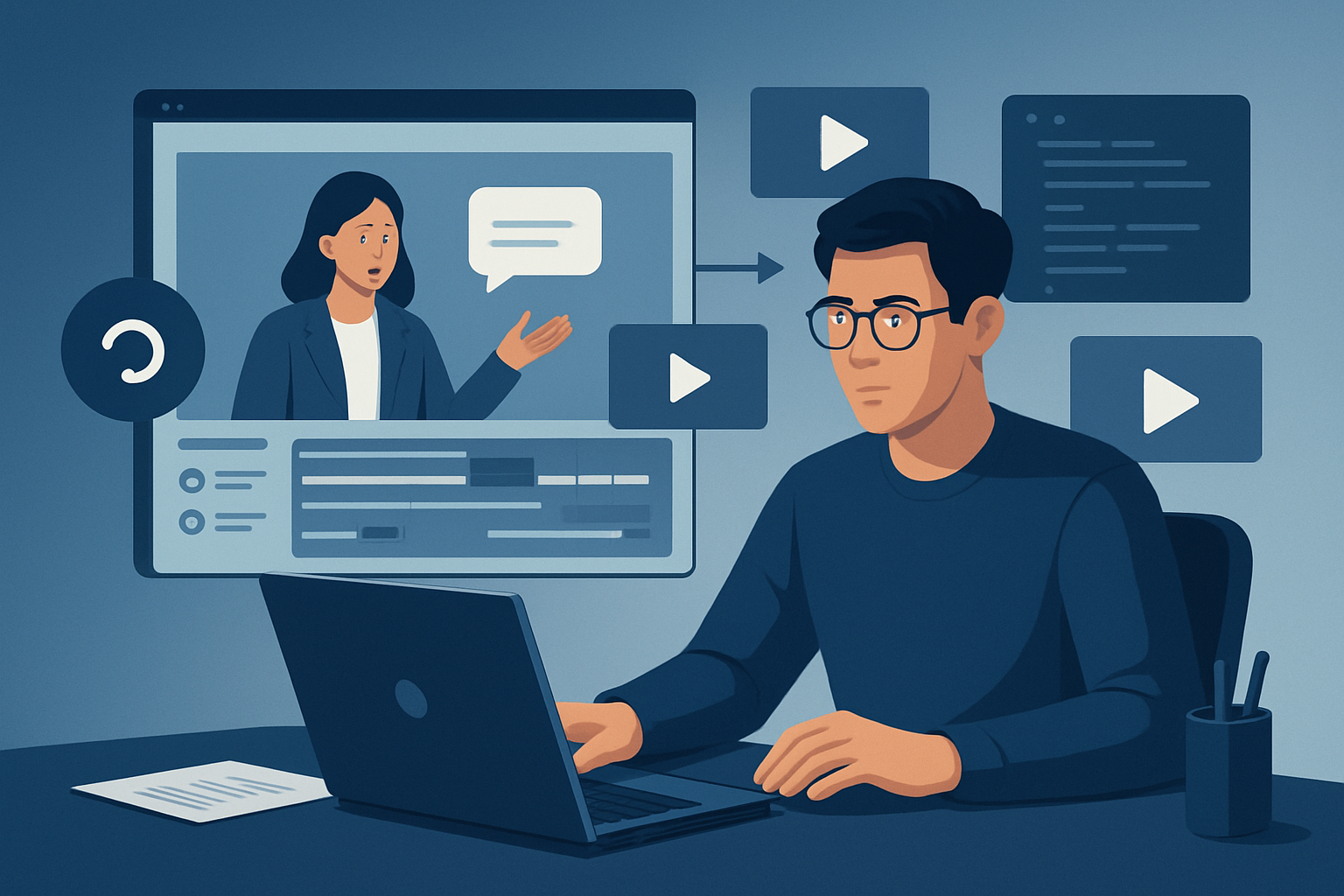
The bottleneck: turning long webinars into consistent short videos, fast
If you repurpose webinars, your core problem isn’t creativity — it’s throughput. You have hours of high-value content trapped in single recordings, and the time-cost of chopping, captioning, resizing, and polishing each clip kills output. The usual enemy is tool switching: transcribe in one app, edit in another, subtitle in a third, then rebuild the same stylistic elements every time.
A practical video repurposing workflow fixes that by compressing repeatable steps into a system that produces faster first drafts, repeatable output, reusable assets, and less tool switching.
Step-by-step workflow: webinar → social-ready clips
Prepare the source
- Gather your webinar recording and any slide decks or speaker assets.
- If the webinar lives online (YouTube/TikTok), download the source URL into your workspace so you always work from a local copy.
Ingest and transcribe
- Import the footage into your production workspace.
- Generate a transcript and let the app analyze speakers and timestamps. Transcripts are your map for highlight extraction.
Mark highlights and create a clip list
- Scan the transcript for soundbites, tips, and quotable moments.
- Create a prioritized clip list (30-90s clips for social, 6-15s hooks, and 1–2 minute deep dives).
Auto-generate edit drafts
- Use an Auto Edit workflow to build initial edits from the selected segments. This automates cuts, adds subtitles, and applies a base template.
- Preview drafts in the target ratios (landscape, portrait, square) and pick the best framing.
Polish the drafts
- Add title hooks, on-screen lower-thirds, and B-roll where necessary.
- Apply visual polish: auto zoom, face tracking, freeze frames, and basic color tweaks to make the clip feel intentional.
- Mix audio levels and add a consistent track or SFX.
Finalize assets
- Generate and store thumbnails and project assets alongside the video outputs.
- Export final files in required codecs and sizes for each platform.
Distribute and schedule
- Push rendered outputs into your publishing queue or scheduler with captions and platform-specific captions/metadata.
Archive for reuse
- Save project presets, overlay packages, and generated asset libraries for the next webinar.
Tools needed
- A desktop editor that supports footage-first repurposing and local project libraries (Shorz is a Windows desktop AI video production suite designed for this pattern).
- A transcription tool (built into some editors or external if preferred).
- An asset manager or shared drive for source webinars and reusable media.
- A social scheduler to queue exports to platforms.
- A QA checklist (device previews, captions accuracy, branding consistency).
If you use Shorz, it handles many of the core steps inside one persistent workspace: import, transcription/analysis, Auto Edit Video generation, subtitles, title hooks, B-roll overlays, visual polish (auto zoom, face tracking, freeze frame), multi-ratio previews, and thumbnail generation. Shorz also stores assets locally in My Assets, supporting repeat workflows and cached project history.
Video Repurposing Workflow for Solo Creators Video Repurposing Workflow for In-House Teams Video Repurposing Workflow for Agencies With Shorz
Common mistakes to avoid
- Skipping transcription: Without accurate timestamps and text, you’ll miss high-value moments and waste time guessing where to cut.
- Editing every clip from scratch: Don’t reinvent overlays, color grades, or titles. Reuse templates and presets.
- Ignoring aspect ratios: One export doesn’t fit all feeds — preview and render portrait, square, and landscape as needed.
- Over-polishing early drafts: Get a publishable first draft fast, then do a light pass for top-performing clips.
- Losing asset provenance: Keep a local, organized asset library (speaker headshots, logos, music stems) so you don’t rebuild assets per clip.
Optimization tips that actually move the needle
- Start with hooks: Identify a 3–8 second hook in the transcript and make it the first frame of the short.
- Use subtitles as design: Treat captions as a consistent visual layer with templates so viewers on mute still engage.
- Reuse B-roll packs: Build short, thematic B-roll libraries to quickly swap into related clips.
- Batch by task: Do all transcribing, then all highlight selection, then all first-pass edits — switching context less saves hours.
- Track templates and outputs: Keep naming conventions and export presets so you can pull metrics later and A/B test thumbnails and hooks.
How to scale this workflow
- Turn the clip list into a reproducible checklist. Every webinar runs through the same nine-step pipeline.
- Maintain a “style pack” of overlays, title hooks, music stems, and thumbnail templates in your asset library.
- Use persistent projects and saved outputs so repeat clients or recurring webinar series don’t start from zero.
- Train junior editors on the Auto Edit → Polish pattern: let the system produce faster first drafts; focus human time on storytelling and performance.
- Measure and iterate: track which hooks and formats drive engagement and bake winners into your style pack.
Where Shorz reduces friction
- Single workspace: Import, analyze, edit, and polish without jumping between multiple apps — fewer handoffs, fewer lost assets.
- Auto Edit Video: Converts long webinar footage into a first-pass edit sequence quickly, compressing the “cutting” phase.
- Reusable local asset library: My Assets stores generated thumbnails, overlays, audio, and downloaded media so you reuse instead of recreate.
- Multi-ratio previews: See how a clip will appear in landscape, portrait, and square before export to avoid platform reworks.
- Finishing controls beyond drafts: The app combines AI generation with finishing controls — subtitles, title hooks, B-roll, auto zoom, face tracking, freeze frames, and volume mix — so first drafts are already close to publishable.
- Download source URLs: Pull webinar uploads directly from YouTube or TikTok into your local project to centralize source material.
These features make it easier to get from webinar recording to publish-ready clips faster, with repeatable asset management and less tool switching.
FAQ
Q: Can I repurpose webinars directly from YouTube into the editor? A: Yes — you can download source material from YouTube or TikTok URLs into your local asset library and start the repurposing workflow.
Q: Will I still need a separate captioning tool? A: Not necessarily. The workflow assumes transcription and subtitle layers are part of the edit workspace. Use external transcription only if you prefer a different engine.
Q: How do I handle multi-clip exports for different platforms? A: Build a single edit, then preview and export in landscape, portrait, and square ratios. Save export presets for each platform.
Q: Is this workflow suitable for agencies and teams? A: Yes. A persistent local workspace and My Assets make it operationally efficient for repeat work, cached assets, and reusable project patterns. It’s positioned to reduce tool sprawl and improve throughput.
Q: How do I keep quality consistent at scale? A: Use style packs, templates, and a strict batch schedule (transcribe → highlight → auto-edit → polish → export). Measure results and refine templates based on performance.
CTA
Ready to compress your webinar repurposing process and output more short-form content with less tool switching? Learn the full system and next steps in our guide: Video Repurposing: Complete Guide. Or explore workflows for solo creators, in-house teams, and agencies to see which pattern fits your operation: Video Repurposing Workflow for Solo Creators, Video Repurposing Workflow for In-House Teams, Video Repurposing Workflow for Agencies With Shorz.